Travel eSIM
Temporary eSIM for International Travel: A Short-Trip Guide
A temporary travel eSIM works best when its coverage, activation trigger, allowance, and validity match the complete trip without locking you into a recurring plan.
- Author
- RoamMatch editorial team
- Reading time
- 6 min read
- Updated
- Updated 2026-07-18
In brief
Choose a temporary eSIM by trip length, destination coverage, data allowance, activation timing, hotspot use, top-ups, and expiry.
Quick answer: a temporary eSIM is a prepaid digital SIM profile or plan intended for a limited trip or validity period. It is useful when you need mobile data abroad without changing your home SIM or starting a long contract. The right plan covers every destination, lasts for the complete journey, and has enough usable data for your phone and any hotspot devices.
Temporary does not describe one standard product. Some plans expire after a fixed number of days, some begin on first network connection, and others begin at installation or purchase. Many are data-only. Compare the exact product rather than assuming every travel eSIM behaves the same way.
Who should use a temporary travel eSIM?
A temporary eSIM is usually a strong fit for holidays, business trips, stopovers, cruises with port coverage, study visits, and multi-country itineraries where the traveler wants data while keeping the home number available.
| Travel situation | Useful plan type | Main check |
|---|---|---|
| Weekend or short city break | Small fixed-data destination plan | Minimum validity and activation timing |
| One- to two-week holiday | Fixed-data or unlimited-style destination plan | Full-speed allowance and hotspot policy |
| Several countries in one region | Regional plan | Every country and territory in the route |
| Remote work | Large fixed-data or clearly disclosed unlimited-style plan | Hotspot, fair use, reduced speed, and top-ups |
| Long stay needing a local number | Local carrier eSIM or physical SIM may fit better | Calls, SMS, identity rules, and local service |
Seven checks before buying
- Coverage: confirm every destination, including stopovers and islands, on the provider's current country list.
- Validity: choose a period that covers arrival through the final travel day, not only the number of hotel nights.
- Activation trigger: determine whether the countdown starts at purchase, installation, manual activation, or first supported-network connection.
- Data allowance: estimate phone use, video, navigation, calls, uploads, and hotspot traffic.
- Hotspot: verify tethering and any separate cap before relying on a laptop or tablet.
- Top-up behavior: check whether more data can be added to the installed profile or whether a new eSIM is required.
- Final seller terms: confirm currency, tax, refunds, support, and plan details at provider checkout.
The travel data calculator provides a practical allowance estimate. If more than one country is involved, compare a destination plan with the multi-country eSIM guide.
Match validity to the itinerary
A seven-day plan is not automatically suitable for a seven-night trip. Arrival and departure times can span eight calendar days, and a delayed flight can extend the period. Add the activation trigger to the calculation before choosing the shortest validity.
Installation and activation are not always the same event. Install on reliable Wi-Fi before departure when the provider permits it, but follow the product instructions about when to switch the line on. The installation timing guide explains the sequence.
Fixed data versus unlimited-style plans
Fixed-data plans are easy to compare because the allowance is explicit. They work well when daily use is predictable and a top-up is available. Unlimited-style plans can reduce monitoring, but they may apply fair-use thresholds, reduced speeds, or separate hotspot limits.
| Plan model | Advantage | What can make it a poor fit |
|---|---|---|
| Fixed data | Clear allowance and price-per-GB comparison | No top-up or a short expiry |
| Unlimited-style | Convenient for variable phone use | Low high-speed threshold or restricted hotspot |
| Pay as you go | Flexible for irregular travel | Harder to predict final trip cost |
| Recurring global plan | Convenient for frequent travelers | Unnecessary renewal for a one-off trip |
For an unlimited-style product, read the high-speed threshold, the period it applies to, the speed after the threshold, and whether tethering has different rules. See the unlimited eSIM hub for a structured comparison.
Do temporary eSIMs include a phone number?
Many temporary travel eSIMs are data-only. Your compatible dual-SIM phone can usually keep the home line available for calls or verification texts while the travel eSIM handles mobile data. Home-carrier roaming charges can still apply to calls, SMS, or accidental data use.
If a local or international number is required, use the eSIM with phone number guide. Do not infer voice service from the word eSIM alone.
Temporary eSIM versus roaming and local SIM
| Option | Often strongest for | Trade-off |
|---|---|---|
| Temporary travel eSIM | Fast setup, short trips, keeping the home SIM | Often data-only and dependent on provider terms |
| Home-carrier roaming | Very short trips or included roaming | Can be expensive outside included destinations |
| Local SIM or eSIM | Long stays, local calls, larger local packages | May require registration, a store visit, or a local process |
| Portable hotspot | Several devices traveling together | Another device to charge, carry, and return |
Compare the total trip cost rather than a daily headline. The travel eSIM versus roaming guide covers the main decision.
Setup checklist
- Confirm that the exact phone model supports eSIM and is carrier-unlocked.
- Save the provider confirmation and installation instructions without exposing the QR code.
- Install with reliable Wi-Fi before departure when allowed.
- Label the new line clearly and select it for mobile data after arrival.
- Disable data roaming on the home line and unwanted cellular-data switching.
- Enable data roaming on the travel line only when the provider instructions require it.
- Test basic browsing and contact provider support before changing APN settings.
How RoamMatch narrows the choice
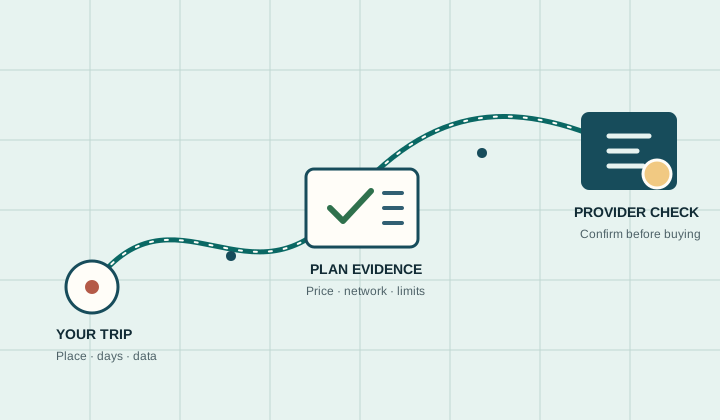
Start with the destination and trip duration, then add expected data, hotspot needs, and buying priority. RoamMatch only displays a sourced price when a current plan record matches the trip conditions. Provider profiles explain broader product policies without presenting them as universal plan facts.
Continue with the international travel eSIM hub, open the provider evidence profiles, or use the trip matcher to build a shortlist.
Frequently Asked Questions
Can I buy a temporary eSIM before traveling?
Usually yes. Buying and installing before departure reduces setup risk, but the product instructions determine when validity begins. Do not activate early if the countdown starts immediately.
How long does a temporary eSIM last?
Validity is product-specific. Common periods range from a few days to a month or more, but the activation trigger and expiry rule matter as much as the stated number of days.
Can I delete the eSIM after the trip?
Yes, but wait until the trip and any support request are finished. Some providers reuse one installed profile for later top-ups or trips, so check the provider guidance before deleting it.
Will a temporary eSIM work in every country?
No. It only works in the destinations and partner networks included in the exact product. Regional labels are not a substitute for checking the country list.
Is a temporary eSIM cheaper than roaming?
It can be, especially when home-carrier roaming is expensive or the trip needs more data. Compare the complete trip price, included data, hotspot rules, and any roaming already included in the home plan.
Continue the decision
Best eSIM for International Travel: Plans, Data, and Coverage
This page consolidates international-travel eSIM variants and keeps similar articles pointed toward one stronger destination for the main keyword.
Open this topic hubRelated reading